
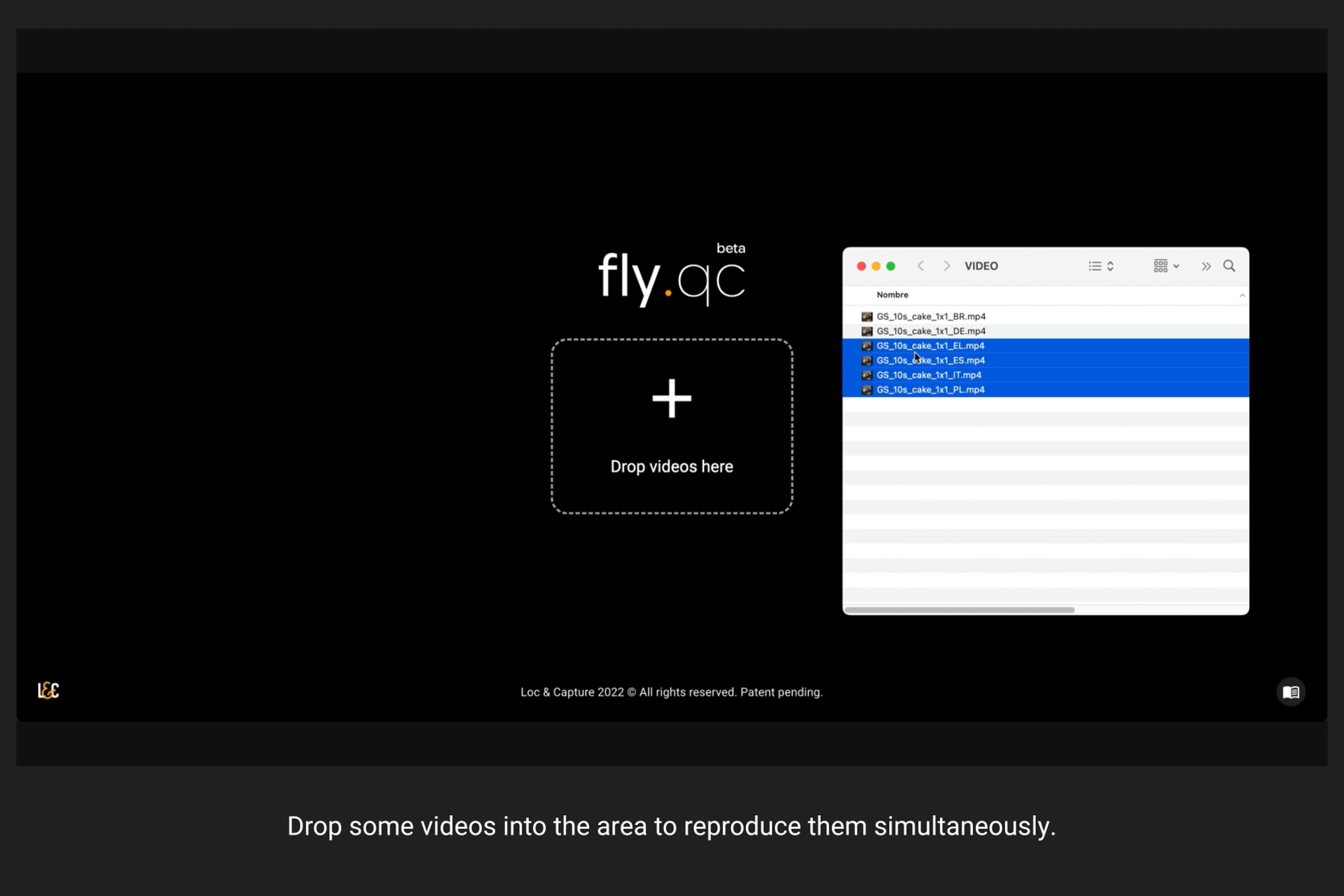
Multi-asset sync playback
Load every localized video or still your workstation can handle and play them in lockstep, with speed controls, frame stepping.

Proprietary quality control

Save reviewing time. Visual QC for localized video, built in-house
fly.qc lets reviewers check all localized versions in parallel, play them in perfect sync, compare them against the master, mark errors and export a shared report, all from one tool
 TAUS Innovator
 Process Innovation
1,852
launches shipped clean last year
0
campaigns recalled from market last year
Fly.QC · Visual localization review
fly.qc brings visual QC for localized marketing assets into one place: sync playback, frame comparison against the master, annotations and exportable reports.
Instead of email threads, drives, spreadsheets, video players and comment trackers, teams review the final material in one shared flow. Built for our own production line, it gives clients and creative agencies hands-on access to catch visual, timing, metadata and layout issues before delivery.
Load every localized video or still your workstation can handle and play them in lockstep, with speed controls, frame stepping.
Compare each version with the master frame by frame. Highlights visual differences on the asset and masks noisy areas to cut false positives.
Check codec, resolution, bitrate, duration, file size and more at a glance. Mismatches are automatically flagged.
Apply broadcast, title and social UI guides across every video to catch clipped text, covered logos or unsafe framing.
Pin comments to the exact video and timecode, draw on the frame, assign category and severity, and export the Excel report.
Save projects and batches, auto-load asset sets, and keep reports beside the files so reviewers can continue without handoff noise.
LEDroom
For stadium and sport-tech campaigns, fly.qc QC runs inline with LEDroom production, so automated campaign assets are verified at generation time, not post-production.
Questions
fly.qc is not licensed standalone. It is included in our integrated production and QC service. When you work with us, your team gets direct access to fly.qc for the duration of the project: open it, run your own reviews, leave comments and export reports.
LSP QC checks the translation. fly.qc adds the parallel, collaborative technical review: text, image, timing and metadata, compared against the reference automatically, all in one platform so teams can work together and generate reports.
All common video formats (mp4 and similar) and still images (jpg, png and similar). Images work the same way as video: load them side by side, compare, annotate and report.
Yes. fly.qc is built to bring everyone onto the same platform, including the agency’s linguists. We send the localized assets through fly.qc to the original creative agency, the agency grants permissions inside the app to its own linguists, and they leave feedback directly on the final material. One conversation, one source of truth, for our QC team, the agency, and the linguists.